This Upper West Side Manhattan guide covers the residential area of uptown Manhattan between 59th and 110th Streets, bounded by the Hudson River and Central Park.
You can visit the Natural History Museum, Lincoln Center, and Riverside Park, and get a bagel from Zabar’s. Give it a day or two to roam around the city.
This guide will assist tourists visiting New York City for the very first time and wishing to discover some quiet places in Manhattan apart from Times Square. These travel tips can be very useful for individuals, couples, or even families traveling for one day or two days.
- Columbus Circle to 110th Street, with Morningside Heights above.
- Broadway is the spine. The 1, 2, and 3 trains run under it.
- The Museum, Lincoln Center, and the Dakota: your main three sights.
- People actually live here, so expect fewer tourists and more corner delis.
- Sunday is market day. Night is jazz night.
What Is the Upper West Side?
The Upper West Side (often shortened to UWS) is a residential neighborhood on Manhattan’s west side that stretches from Columbus Circle at 59th Street to West 110th Street. It is known for historic apartment buildings, museums, performing arts venues, riverside parks, and local food institutions.
Where It Is and How It’s Laid Out
The avenues stack west to east: Riverside Drive, West End, Amsterdam, Columbus, and Central Park West. Broadway cuts across all of them on a diagonal for 66 blocks, past Lincoln Square at 65th and Verdi Square at 72nd. Wikivoyage’s neighborhood rundown describes that diagonal as the backbone of the place.
Start at Columbus Circle. Looks like a glorified roundabout, but it’s the zero point: all distances to New York City are measured from there. Below, you’ll find the Turnstyle Underground Market, while above it are the Deutsche Bank Center and a basement Whole Foods.
Getting Around Without Losing Your Mind
The 1 train stops everywhere: 66th (Lincoln Center), 79th, 86th, 103rd, and 116th (Columbia). The 2 and 3 run express and skip most stops.
The B and C run under Central Park West, and the 81st stop drops you inside the museum. Otherwise: the M104 bus or a Citi Bike along the Hudson River Greenway.
The Main Attractions
American Museum of Natural History
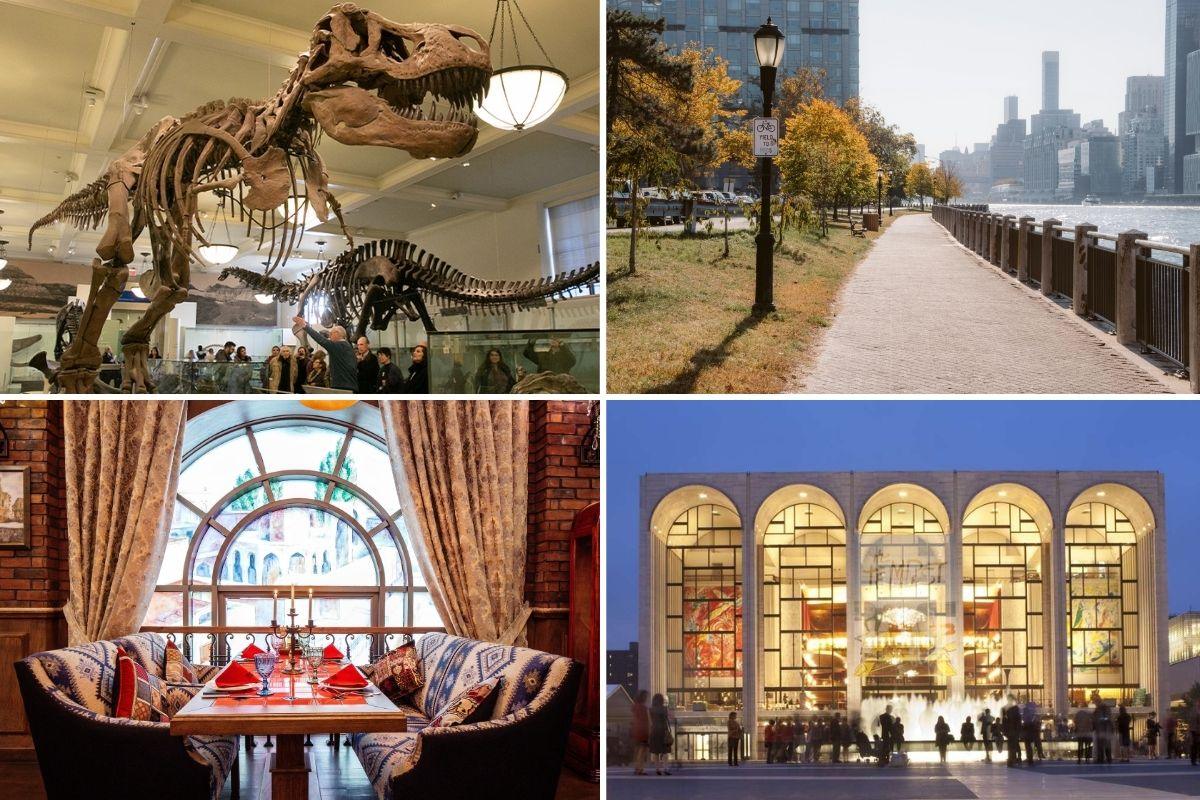
Central Park West, 77th to 81st. There are 26 buildings, 45 galleries, a blue whale above the Milstein Hall of Ocean Life, fourth-floor dinos, and the Hayden Planetarium inside a seven-story glass cube. Entry tickets cost from $28 to $30, and those from New York, New Jersey, and Connecticut pay whatever they wish.
Lincoln Center
From 62nd to 66th. The Metropolitan Opera hides behind five glass arches, with two Marc Chagall murals inside. Next door: the David H. Koch Theater (New York City Ballet, The Nutcracker every December), David Geffen Hall (the Philharmonic), and Juilliard. Culture Trip makes a good point that skipping Juilliard’s student shows would be a crime.
The Dakota
1 West 72nd. John Lennon lived here and was shot outside the entrance on December 8, 1980. Yoko Ono still lives here. Cross into Central Park for the Imagine mosaic at Strawberry Fields.
The Ansonia
It is at 2109 Broadway and once housed Babe Ruth, Caruso, Stravinsky, and Toscanini. The San Remo has those twin towers from a hundred movies. The Apthorp and the Belnord opened in 1908.
RELATED STORIES


Riverside Park
Everybody walks Central Park. Locals walk Riverside. It’s a thin green strip along the Hudson: four miles of paths, real river views, and monuments dotted through it.
Eleanor Roosevelt is at 72nd. The Soldiers’ and Sailors’ Monument at 89th, where Shakespeare is staged on the steps in the summer. The Firemen’s Memorial at 100th Street. Travel For a Living, a travel blog, notes that you can walk south through Riverside Park South and Hudson River Park to Battery Park.
At 122nd Street, Ulysses S. Grant and his wife Julia lie in Grant’s Tomb, the largest tomb in the UWS and in North America. It is free to look.
East, at 112th and Amsterdam, stands the Cathedral of St. John the Divine, the world’s largest neo-Gothic cathedral, still unfinished after a century. Locals call it St. John the Unfinished. Peacocks live on the grounds. Entry is about $10; the vertical tour up the spires is about $25.
Above it: Columbia University, founded in 1754 as King’s College. The campus is closed to outsiders now, so book a tour. Worth it for Low Library’s rotunda, the largest all-granite dome in America, and the Alma Mater statue by Daniel Chester French, who also made the Lincoln Memorial.
Where to Eat
Zabar’s, at Broadway and 80th Street. Family-run since 1934. Lox, cheese, smoked fish, a cafe on the corner, and nobody’s redecorated since the Eisenhower years. Barney Greengrass on Amsterdam has sold smoked fish since 1908 and calls itself the Sturgeon King. Platters get pricey, so order eggs with fish on the side.
Gray’s Papaya at 72nd for hot dogs, Koronet Pizza near Columbia for a jumbo slice the size of your forearm, Flor de Mayo for Peruvian-Chinese rotisserie chicken with garlic sauce, and Tom’s Restaurant at 112th, the Seinfeld diner. Condé Nast Traveler’s editors say that the service is affably gruff, and you’ll love it anyway.
Levain Bakery does cookies the size of hockey pucks, Alice’s Tea Cup does scones, and The Hungarian Pastry Shop opposite the cathedral opened in 1963 and still has no Wi-Fi.
Fairway and Citarella for market browsing, Jacob’s Pickles for absurd portions of buttermilk fried chicken, and Banksy’s “Hammer Boy” on 79th, painted in 2013 and now behind Perspex.
Markets and Nights Out
On Sundays, there is Grand Bazaar NYC located at 77th and Columbus, having around 100 vendors operating from 10 to 5 o’clock. It is New York’s largest weekly marketplace. On Thursdays and Saturdays, farmers’ markets can be visited in Tucker Square.
In the evenings, Smoke Jazz & Supper Club at 106th provides live music performances seven days a week. There is also Dizzy’s Club located at Lincoln Center, offering a view of the skyline.
There have been Rolling Stones, Queen, and Aerosmith in Beacon Theatre, which sell out very quickly. In the Dive Bar at 96th, one will get beer as cold as his or her ex’s heart starting at five dollars.
What to Visit Based on Your Interests
| If You Like | Visit |
|---|---|
| Museums | Natural History Museum |
| Architecture | Dakota |
| Nature | Riverside Park |
| Food | Zabar’s |
| Shopping | Grand Bazaar NYC |
| Music | Smoke Jazz Club |
FAQs
1. Is the Upper West Side worth visiting?
Yes, specifically after you’ve survived Times Square. It’s calm, green, and home to the museum and Lincoln Center.
2. How many days do I need to roam UWS Manhattan?
One full day covers the highlights. Two days let you add Columbia, Grant’s Tomb, and a real walk through Riverside Park without rushing.
3. Is it safe for tourists?
It’s one of Manhattan’s safer, residential neighborhoods. Use normal city sense in the parks after dark.
4. What is the Upper West Side of Manhattan famous for?
Pre-war buildings, Zabar’s, Lincoln Center, and movies. You’ve Got Mail, Ghostbusters, and Seinfeld were all filmed here.
5. How do I get to the Upper West Side from Times Square?
Take the 1, 2, or 3 uptown from Times Square-42nd Street. You’ll hit 72nd in ten minutes.
6. What’s the best time of year to visit?
Late spring or early fall. Parks are green, outdoor tables are out, and walking it all is easy.
Sources & References:
- Wikivoyage – The diagonals of the Upper West Side of Manhattan’s Broadway are the backbone of the place.
- Travel For a Living – You can walk south through Riverside Park South and Hudson River Park to Battery Park.
- Culture Trip – Skipping Juilliard’s student shows would be a crime.
- Conde Nast Traveler – The service at UWS Manhattan’s cafes and restaurants is very friendly.