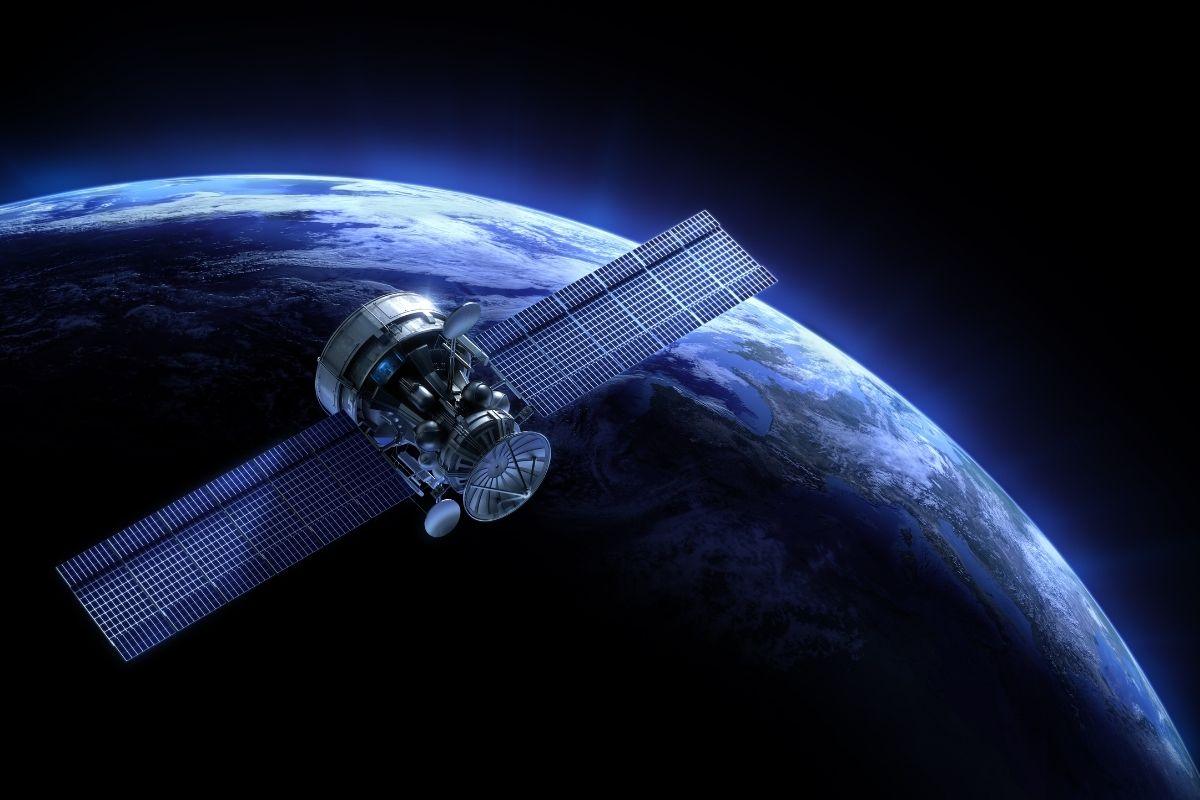
Quick Answer: Researchers in China hit 1 gigabit per second from geostationary orbit using a laser that draws just 2 watts of power. For comparison, that’s less than most night lights use. The demo, built around 2-watt laser satellite communication, ended up faster than what Starlink typically delivers to users.
Short Summary: What made it work wasn’t more power; it was smarter engineering. The team built their receiving system around a method called AO-MDR synergy, which lets a badly scattered laser beam still deliver usable data by piecing together whatever fragments survive the trip through the atmosphere. That’s the whole idea behind this particular 2-watt laser satellite communication breakthrough. Two watts is a small number, about the same draw as a night light on your nightstand. Researchers from Peking University and the Chinese Academy of Sciences ran the test through a 1.8-meter telescope with 357 micro-mirrors, based in southwestern China. Reliability climbed from 72% to 91.1% with this technique in place. It’s still a single test, not a live network, but it’s a solid sign of what might come next.
- Researchers achieved 1 gigabit per second data transmission using a 2-watt laser from geostationary orbit, roughly 36,000 kilometers above Earth.
- The team was affiliated with Peking University and the Chinese Academy of Sciences.
- The 2-watt power draw is comparable to a small LED night light, far below the 10W laser and 50W radio frequency power typically used on Starlink satellites.
- The breakthrough relied on 357 micro-mirrors and a technique combining adaptive optics with mode diversity reception, described as AO-MDR synergy.
- Usable signal reliability rose from 72% to 91.1% using this method.
- The demonstration outpaces typical Starlink user speeds by roughly a factor of 5 to 10, though the comparison involves different measurement conditions.
- Geostationary orbit sits at roughly 65 times the altitude of Starlink’s low Earth orbit satellites.
Why This Distance Matters?
Put it in perspective: geostationary orbit sits roughly 36,000 kilometers above Earth, over 90 times higher than the ISS and about 65 times the altitude of Starlink’s satellites, which orbit closer to 550 kilometers up. That extra distance isn’t wasted, though. A satellite that far out can see almost half the planet at once, which is why it’s been used for weather tracking, TV signals, and military comms for years. But that same distance is exactly what makes 2-watt laser satellite communication over this range such a tough engineering challenge.
The tradeoff has always been distance and turbulence. Signals sent from that far away take roughly half a second for a round trip, a delay baked into the physics of the distance itself. Laser signals in particular have historically struggled to survive the trip down through Earth’s atmosphere at high data rates over such a long path, because atmospheric turbulence scatters and distorts a laser beam long before it reaches a ground receiver.
How They Actually Did It?
Here’s what sets this apart from earlier tries. Instead of fighting the atmosphere and hoping the beam survives the trip intact, the team designed their system around the assumption that it wouldn’t. They let the beam scatter, then rebuilt the signal from the pieces that got through.
At an observatory in southwestern China, their 1.8-meter telescope is fitted with 357 micro-mirrors and a multi-plane light converter. This combo, nicknamed AO-MDR synergy, short for adaptive optics and mode diversity reception, sorts through the scattered fragments, finds the ones still carrying a real signal, and reconstructs the data from those. That’s essentially the engine behind this 2-watt laser satellite communication breakthrough. Reliability jumped from 72% to 91.1% once they got this working.
Why 2 Watts Is the Genuinely Surprising Part?
Most satellite laser transmitters run considerably hotter than this. A study published in IEEE Vehicular Technology Magazine puts Starlink’s laser transmit power at around 10 watts, and conventional Ka-band radio frequency transmission from geostationary satellites at roughly 50 watts. The Chinese demonstration achieved its result at a fraction of that, roughly comparable to the output of a small household night light.
That’s the part of the story that challenges a longstanding assumption in satellite engineering: that raw power output is what determines how far and how reliably a signal can travel. This demonstration suggests that smarter signal processing on the receiving end can substitute for brute-force power on the transmitting end, at least for optical links across very long distances. That has direct implications for how future 2-watt laser satellite communication systems might be designed for low-power, high-reliability applications.
RELATED STORIES


What This Doesn’t Mean?
It’s worth being precise about what was actually demonstrated here. This was a single dedicated laser downlink under controlled conditions, not a functioning consumer internet service. Starlink’s advertised user speeds reflect a shared radio frequency network serving millions of consumer terminals simultaneously, subject to congestion, weather, and the physical limitations of low Earth orbit hardware. This Chinese demonstration measured one clean laser link between one satellite and one ground telescope. Comparing the two directly, while the headline numbers make for a striking comparison, involves genuinely different measurement conditions, and the technology has not yet been proven at consumer network scale.
That caveat doesn’t diminish what was actually achieved. It just means the practical, at-scale applications, if they materialize, are still some distance away.
Why It Matters Anyway?
The bigger implication sits in what this means for future satellite communication architecture generally. Optical laser links offer higher bandwidth per connection, reduced risk of interference or interception compared to radio frequency signals, and greater power efficiency, which matters enormously for satellite design given how tightly power budgets are constrained in orbit. If lower-power laser systems can reliably deliver high-bandwidth links across geostationary distances, that could reduce how much a satellite needs to be built around raw transmission power, potentially enabling smaller, lighter, and cheaper satellite payloads capable of similar performance.
Researchers involved in the field have suggested the underlying approach could eventually support applications ranging from high-capacity backbone data relays in remote regions to more resilient disaster communication networks, and potentially inform how future deep space communication systems are designed. Whether any of that becomes reality at meaningful scale is still an open question. What’s not in question is that a 2-watt laser just did something laser communication over that distance has never reliably managed before.
FAQs
What did the Chinese research team actually achieve with the 2-watt laser?
They demonstrated a stable 1 gigabit per second data downlink from a satellite in geostationary orbit, roughly 36,000 kilometers above Earth, to a ground telescope in southwestern China, using only 2 watts of laser power.
How does 2 watts compare to normal satellite transmission power?
It’s a fraction of typical power levels. Starlink satellites use roughly 10 watts for laser transmission and around 50 watts for radio frequency transmission. The 2-watt output used in this demonstration is comparable to a small LED night light.
Does this mean Chinese satellite internet is faster than Starlink?
Not directly comparable. This was a single dedicated laser link under controlled test conditions, not a functioning consumer network. Starlink’s advertised speeds reflect a shared radio frequency network serving many users simultaneously. The comparison highlights a technical achievement, not a working consumer service.
How did they overcome atmospheric interference at that distance?
The team used 357 micro-mirrors and a technique combining adaptive optics with mode diversity reception, reconstructing a usable signal from the scattered fragments of the laser beam rather than trying to prevent atmospheric distortion entirely.
What are the practical applications of this technology?
Potential applications include high-capacity data relay networks, improved communications in remote or disaster-affected areas, and more power-efficient satellite communication systems generally, though the technology has not yet been demonstrated at consumer network scale.
Sources and References
- SlashGear – China Beamed Gigabit Internet From Space Using Low-Power Lasers
- Daily Galaxy – Chinese Orbiter Crushes Starlink With a 2-Watt Laser From 36,000km Above Earth
- Indian Defence Review – Chinese Satellite Obliterates Starlink With 2-Watt Laser From 36,000 KM Above Earth
- Futura Sciences – How a 2-Watt Laser Outperformed the Satellite Giants
- SatBase – China Shows Off a 2-Watt GEO Laser Satellite
- National Today – China’s 2W Laser Beats Starlink: 1Gbps from 36,000km