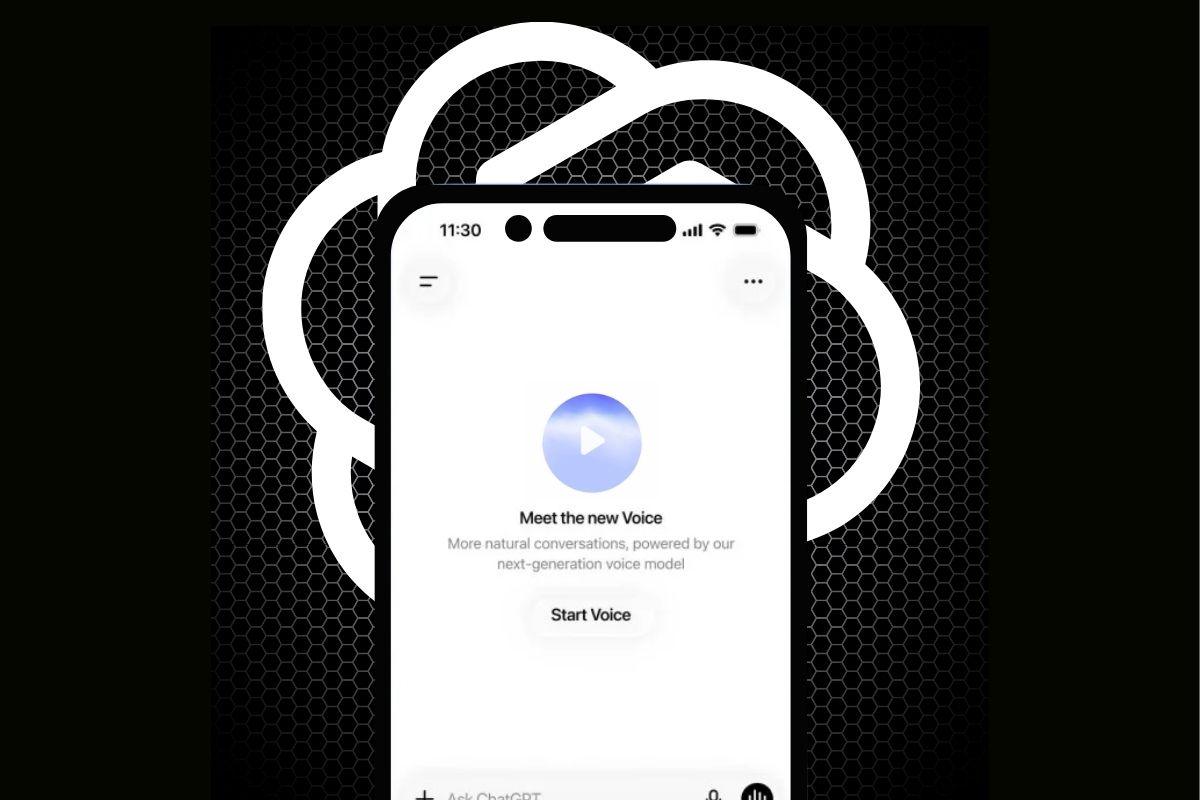
GPT-Live is OpenAI’s new full-duplex voice model that lets ChatGPT listen and speak at the same time. It replaces Advanced Voice Mode and is rolling out globally for Free, Go, Plus, and Pro users across iOS, Android, and the web. It follows two updates to ChatGPT voice tech in the last two years and is geared towards addressing the two major challenges of AI voice assistants.
- GPT-Live is a full-duplex voice model that allows listening and speaking simultaneously without having to wait for quietness.
- Two models are released by OpenAI, namely GPT-Live-1 (default for Go, Plus, and Pro users) and GPT-Live-1 mini (default for Free users).
- GPT-Live can delegate complex tasks — web search, deep reasoning, agentic work — to a frontier model (GPT-5.5 at launch) in the background while keeping the conversation flowing.
- In human evaluations, GPT-Live-1 was preferred over Advanced Voice Mode 75.7% of the time, and GPT-Live-1 mini was preferred 69.2% of the time.
- The model adds dedicated voice-specific safety training, covering self-harm, psychosis and mania, emotional reliance, violence, and sexual content.
- API access is not yet available; OpenAI says it’s coming soon via a developer sign-up list.
- Video and screen-sharing support in voice mode is not yet available at launch, unlike some competing products.
What Is GPT-Live?
GPT-Live is OpenAI’s newest full-duplex voice AI model that allows ChatGPT to listen and speak simultaneously, making conversations feel much more natural than previous voice modes. It will replace the current Advanced Speech Mode of the popular chatbot as the default spoken interface. OpenAI says it operates in a full-duplex configuration, which means the model is not operating in rigid turns but is both processing what the user is saying and generating its own answer at the same time. It can slip into little acknowledgement noises like “mhmm” or “yeah” during a discussion, go through fast back-and-forth exchanges, or just hold calm space while someone collects their thoughts.
Unlike previous voice systems, GPT-Live is not merely a speech layer on top of a chat model – it makes real-time judgements, several times a second, whether to speak, to continue listening, to pause, to interrupt, or to reach for a tool. Because it draws on newer GPT models behind the scenes, it can also surface information visually — showing cards for things like weather, stocks, or sports scores mid-conversation, not just describing them out loud.
Why Did OpenAI Replace Advanced Voice Mode?
Advanced Voice Mode still relied on turn-based conversations that waited for users to stop speaking. GPT-Live removes this limitation by listening and responding simultaneously.
Original ChatGPT Voice (2023)
This system chained together three separate models — Whisper for speech-to-text, GPT-4 to generate a reply, and a separate model to convert that reply back into audio. Each handoff added processing time, and independent analysis has estimated the old pipeline stacked up close to two full seconds of dead air before a response even began.
Advanced Voice Mode
This folded audio processing into a single model, cutting latency and smoothing things out — but conversations still moved through separate, discrete turns. The system had to detect a pause in speech before it would reply, so background noise or someone briefly collecting their thoughts could get misread as the end of a turn, causing awkward, mistimed interruptions.
GPT-Live (2026)
The full-duplex design removes that “wait for silence” bottleneck. Rather than handling a conversation as a series of separate back-and-forth messages, the model continuously listens while it speaks, closing the gap between how a person naturally talks and how the AI responds.
How Smart Is GPT-Live?
GPT-Live can delegate complex reasoning, web searches, and multi-step tasks to GPT-5.5 while keeping conversations flowing naturally.
GPT-Live isn’t just about smoother audio — OpenAI is positioning it as its smartest voice model yet. For anything that needs web search, deeper reasoning, or multi-step agentic action, GPT-Live quietly hands the task to a more powerful background model while keeping the spoken exchange going, then folds the answer back into the conversation once it’s ready. At launch, that background model is GPT-5.5, and OpenAI has indicated it plans to keep upgrading which frontier model powers this handoff as newer ones become available.
In head-to-head evaluations of five- to ten-minute conversations, human testers reportedly preferred GPT-Live-1 over Advanced Voice Mode 75.7% of the time, and preferred GPT-Live-1 mini 69.2% of the time, judged on turn-taking, interruption handling, and overall naturalness. OpenAI also reports that GPT-Live-1 outperformed Advanced Voice Mode on scientific-reasoning and agentic web-search benchmarks.
RELATED STORIES


Safety and Guardrails
GPT-Live includes dedicated voice-specific safety training covering self-harm, emotional reliance, violence, sexual content, and voice impersonation.
“Because full-duplex voice is a genuinely new kind of interface, we built out audio-specific safety evaluations rather than relying on text-based testing alone,” adds OpenAI. The effort involved delicate areas such as self-harm, psychosis and mania, emotional over-reliance on AI, violence and sexual material, with internal red-teamers explicitly looking for hazards unique to spoken contact. OpenAI claims GPT-Live is better than Advanced Voice Mode in most categories tested, or performed at the same level.
The business has also put in measures against voice cloning and impersonation, saying the system is made for conversation, not mimicry, with safeguards designed to prevent it from copying a genuine person’s voice. It’s published as a direct response to the 2024 backlash suffered by OpenAI when a ChatGPT voice was removed after parallels to actress Scarlett Johansson and the controversy brought to the attention of SAG-AFTRA and Congress lawmakers. Parental settings also allow parents to select whether teen accounts may use ChatGPT Voice at all.
Who Can Use GPT-Live?
GPT-Live is rolling out globally on iOS, Android, and the web. Free users receive GPT-Live-1 mini, while paid subscribers get GPT-Live-1.
- GPT-Live-1 is becoming the default voice model for ChatGPT Go, Plus, and Pro subscribers.
- GPT-Live-1 mini is becoming the default for Free-tier users.
- The rollout is global, spanning iOS, Android, and the ChatGPT web app.
- OpenAI says more than 150 million people already use ChatGPT Voice and Dictation weekly.
- API access is not available at launch. Developers and enterprises can join a waitlist; OpenAI says GPT-Live is coming to the API soon.
- Legacy Standard and Advanced Voice Mode options remain available where currently supported.
- Video and screen-sharing within voice conversations are not supported yet, though OpenAI says that capability is in progress.
How Does GPT-Live Compare With Other AI Voice Assistants?
GPT-Live offers one of the most natural voice experiences available today, although competitors like Gemini Live still provide camera and screen-sharing features.
- Google Gemini Live already supports full-duplex conversation plus live camera and screen sharing — a capability GPT-Live notably lacks at launch. Google shipped an updated Gemini Flash Live model in March as a low-latency real-time audio option for developers.
- ByteDance’s Seeduplex, launched in April inside the Doubao app, claims to be the first production-scale full-duplex speech system, reporting roughly a 50% cut in false-response and false-interruption rates compared with ByteDance’s earlier half-duplex system.
- Nvidia’s PersonaPlex, released in January, added customizable voice and role control to full-duplex models — addressing a limitation where natural-sounding voice systems were locked to a single fixed voice.
This context matters for anyone deciding between voice AI platforms: GPT-Live’s full-duplex conversation ability catches OpenAI up to rivals in some respects (Gemini’s camera and screen sharing), while its mid-conversation delegation to a frontier reasoning model pulls it ahead in others. The real differentiators right now are multimodal input support, API availability, latency benchmarks, and voice customization — areas where competing products vary widely and where OpenAI still has visible gaps to close.
Does GPT-Live Have an API?
Not yet. OpenAI says GPT-Live API access is coming soon, and developers can join the waitlist.
For developers already building with OpenAI’s realtime voice infrastructure (separate from the consumer ChatGPT Voice rollout), OpenAI’s existing Realtime API models are priced as follows: its flagship realtime model costs $32 per million audio input tokens ($0.40 for cached input) and $64 per million audio output tokens; a dedicated translation model runs $0.034 per minute; and a streaming transcription model costs $0.017 per minute. Pricing for GPT-Live itself has not yet been announced for API use, since API access hasn’t launched.
Our Analysis
After reviewing OpenAI’s launch announcement and comparing GPT-Live with previous ChatGPT Voice updates, the biggest improvement is conversational flow rather than just speed. Because GPT-Live continues listening while speaking, interruptions feel more natural and conversations require less repetition. Although Gemini Live still offers camera and screen-sharing features, GPT-Live’s integration with GPT-5.5 gives it an advantage for reasoning-heavy conversations.
Frequently Asked Questions
1. What is GPT-Live from OpenAI?
GPT-Live is OpenAI’s newest voice AI model family, built on a full-duplex architecture that lets ChatGPT listen and speak at the same time. It replaces Advanced Voice Mode as the default voice experience in ChatGPT.
2. How is GPT-Live different from ChatGPT’s old Advanced Voice Mode?
Advanced Voice Mode processed conversations in rigid turns and waited for silence before responding, which could cause awkward interruptions. GPT-Live processes incoming audio continuously while generating its own response, enabling natural interruptions, quicker back-and-forth, and acknowledgment cues like “mhmm.”
3. Is GPT-Live available to everyone, and is it free?
Yes. GPT-Live-1 mini is rolling out as the default for Free ChatGPT users, while the larger GPT-Live-1 model is becoming the default for Go, Plus, and Pro subscribers, across iOS, Android, and the web.
4. Can developers access GPT-Live through the API?
Not yet. OpenAI says API access is coming soon and has opened a sign-up list for developers and enterprises interested in early access.
5. What safety measures does GPT-Live include?
OpenAI added voice-specific safety training covering self-harm, psychosis and mania, emotional over-reliance, violence, and sexual content, plus safeguards meant to prevent the model from impersonating real people’s voices. Parental controls let parents restrict teen access to ChatGPT Voice.
Bottom Line
GPT-Live represents OpenAI’s biggest voice upgrade since ChatGPT introduced voice conversations. By combining full-duplex speech with GPT-5.5 reasoning, it delivers faster, more natural interactions while improving safety and conversational quality. Although features like video sharing and API access are still missing, GPT-Live establishes a strong foundation for the next generation of AI voice assistants.
Sources
- OpenAI — Introducing GPT-Live
- OpenAI — Advancing voice intelligence with new models in the API
- VentureBeat — OpenAI launches GPT-Live, a full-duplex voice upgrade
- TechCrunch — OpenAI releases new voice models for more natural live conversations
- EdTech Innovation Hub — OpenAI rolls out GPT-Live voice models in ChatGPT
- Pulse2 — OpenAI Introduces GPT-Live To Power More Natural ChatGPT Voice Interactions
- MacRumors — OpenAI Introduces GPT-Live to Make ChatGPT Voice Feel Like a Real Conversation
- Seeking Alpha — OpenAI unveils GPT-Live voice models to power ChatGPT