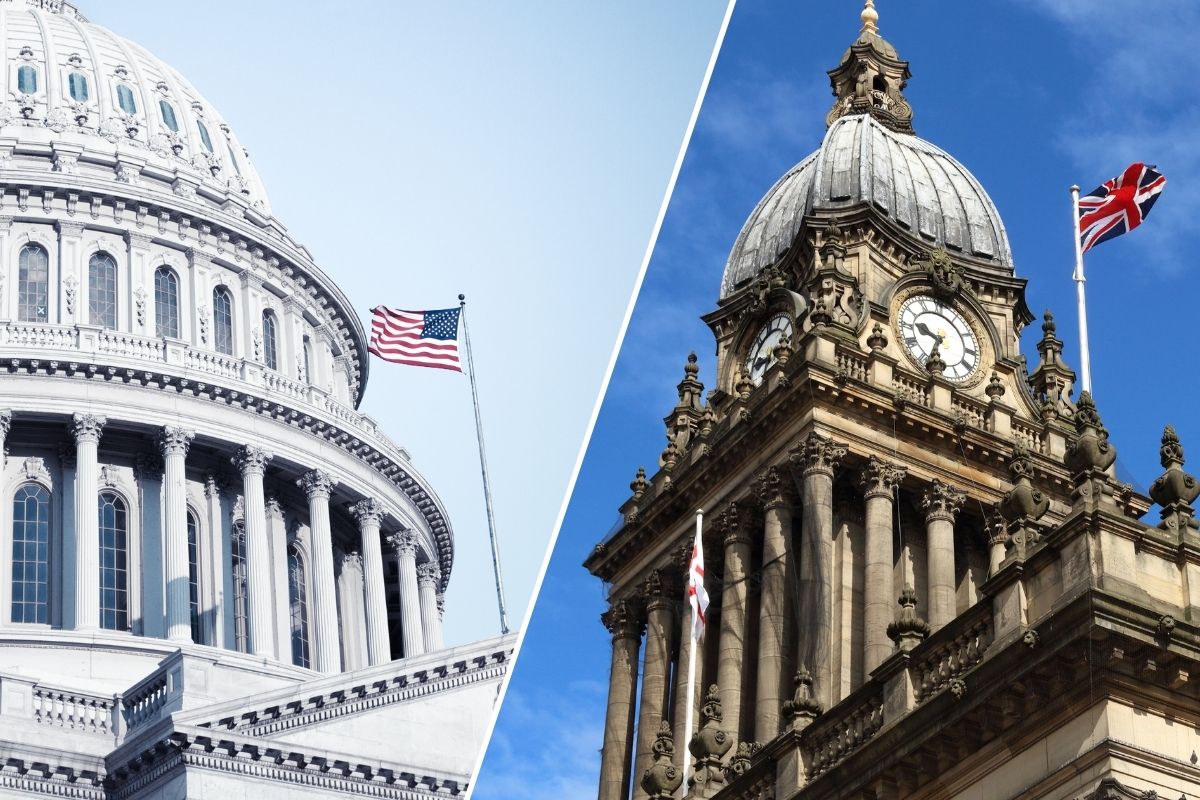
Courtrooms make for great television drama. But real-world law is a messy, high-stakes game that costs real money. When examining the US legal system vs UK legal system, people often assume they are identical because both countries trace their roots back to the old English common law. They aren’t. Not even close.
While both systems rely heavily on past court decisions to set rules for the future, the machinery operating behind the scenes is completely different. One country splits up its power across fifty different states. The other keeps things tied to a much tighter, more centralized setup.
To help clear up the confusion, here is a breakdown of how the two systems operate, complete with their distinct courtroom setups and the mechanics of their jury processes.
The Core Differences at a Glance
Before jumping into the fine print, this side-by-side comparison shows exactly how the two legal powerhouses diverge on a daily basis.
Head-to-Head Comparison: How the Systems Stack Up
| Feature | United States (US) | United Kingdom (UK) |
| Basic Law System | Uses a dual court system with both federal and state laws. | Uses a centralized system for England and Wales, with variations in Scotland and Northern Ireland. |
| Courtroom Roles | The term lawyers or attorneys applies to everyone. Any attorney can advise you and argue in court. | Split into two roles: solicitors do the legal paperwork; barristers argue in front of the judge. |
| How Juries Work | Essential to the US legal system vs UK legal system comparison. Used for both minor/major crimes and civil lawsuits. | Strictly reserved for serious criminal cases. Almost never used for civil cases. |
| Reaching a Verdict | The UK vs US jury system differs here too. Federal trials in the US require a unanimous verdict. | Juries in England and Wales can reach a majority verdict (like 10-2) if they get stuck after several hours. |
| The Constitution | Tied to a single, written document. Judges can throw out laws if they are unconstitutional. | No single written document. Parliament has the final say, and judges cannot simply strike down their laws. |
The Dual Court Trap Against the Unified Crown
In the United States, you aren’t just dealing with one set of laws. You are dealing with two separate layers at all times. There is the federal system, which handles big national issues like bankruptcy or federal crimes. Then you have the state courts, which handle the everyday stuff like divorces, car accidents, and local property disputes.
This means that a business owner in California operates under completely different rules than one in Texas. It creates a massive headache for companies trying to run a business across state lines.
The United Kingdom takes a much more unified approach.
The UK does not have a federal system of states. Instead, it relies on a mostly unified system for England and Wales, with separate variations for Scotland and Northern Ireland.
When a decision comes down from the High Court in London, it carries immediate weight across the region. There is no messy fighting over state rights versus federal rights. It makes the system far more predictable, even if it feels a bit old-school to outsiders.
Also Read: Hidden Gems in the Catskills That New Yorkers Love
The UK vs US Jury System: Who Decides Your Fate?
This is where the real drama happens. If you are ever facing a major lawsuit or a criminal charge, who sits in the box to decide whether you walk free or pay up makes all the difference in the world.
The UK vs US jury system highlights two completely different views on civic duty and legal strategy.
In the United States, the jury is a core part of the culture. It is protected by the Constitution. This means juries get called in for almost every type of case imaginable.
- Got into a bad car crash and suing for damages? You can ask for a jury.
- Facing a felony charge? You get a jury.
And the jury selection process in America, known as voir dire, is an absolute art form. Lawyers spend days asking potential jurors about their hobbies, their political views, and their media habits just to find the right people.
According to civil procedure guides at FindLaw, American criminal juries must reach a completely unanimous verdict to convict someone at the federal level. If even one person holds out, the whole thing falls apart and goes to a mistrial.
The UK does things differently.
Juries are almost never used in civil trials anymore. You can’t get a jury for a standard contract dispute or a personal injury claim in London. They are reserved strictly for serious criminal cases in the Crown Court.
More importantly, the UK does not let lawyers spend hours grilling potential jurors. You are summoned, and unless you have a clear conflict of interest, you take your seat and hear the evidence.
But what if the jurors cannot come to a unanimous conclusion after deliberating for just a few hours? A judge may intervene and accept a majority verdict such as 10–2. Indeed, recent updates in places such as Scotland have made verdict rules even more distinctive, including a two-thirds majority (10 out of 15 jurors) for a conviction. That keeps the wheels of justice turning, avoids mired juries, and prevents trials from becoming months-long sagas.
Barristers, Solicitors, and the All-American Attorney
Walk into a standard law office in New York or Chicago. You will meet an attorney. That single person can write your will, draft your business contracts, and then walk right into court to defend you before a judge.
They are a one-stop shop.
The legal profession in England and Wales is still firmly divided into two camps:
- Solicitors: The office-based experts. They take care of the paperwork, write up contracts, manage real estate deals and give direct advice to clients. But they rarely go to argue a case in the higher courts.
- Barristers: Courtroom experts. They are the ones who don the old-fashioned wigs and gowns. They spend all their time arguing with judges and juries.
Companies in London do not directly employ barristers when they are sued. They go to a solicitor first. That solicitor then engages a barrister to conduct the courtroom fight. It is almost as if you have a general doctor, and he refers you to a surgeon when things get serious.
The Written Constitution Problem
Here is another huge point of friction when comparing the US legal system vs UK legal system. The Americans have one final document that reigns supreme — the US Constitution. If Congress passes a law that violates the Constitution, the US Supreme Court can nullify it and make it disappear. That gives the judges in Washington, D.C., huge political power.
There is no single written constitution in the UK. Instead, they work off a hodge-podge of vintage laws, precedent, and century-old practices. The ultimate power sits with Parliament.
The UK Supreme Court cannot simply strike down an Act of Parliament because it infringes a constitutional principle. The judges have to apply the law as written. It has thus made the British system far more dependent on the political process rather than the courtroom.
The Bottom Line
There is no single correct way of running a legal system. In America, individual citizens wield this immense power through the jury box and local courts. That gives a ton of individual rights protection to people, but it can also be incredibly capricious and very costly.
The British legal system focuses on speed versus predictability and professionalism.
Also Read: Is Elon Musk’s xAI a Real Threat to OpenAI?
FAQs
Does the UK still use the death penalty?
No. It was completely abolished for all crimes back in the late 1960s. In contrast, the death penalty is still an option in many American states and at the federal level for certain major crimes.
Why do British barristers wear those white wigs?
It is a tradition that dates back to the late 17th century. While it looks unusual to American eyes, the legal community in the UK views it as a way to maintain solemnity and take personal identity out of the equation.
How many people sit on a jury in these systems?
In both countries, a standard criminal jury consists of 12 people. However, in Scotland, the system uses 15 jurors.
Can anyone view a trial in these courts?
Generally, yes. Both systems operate on the principle of open justice. Members of the public can sit in the gallery for most criminal and civil proceedings.
How long does a standard trial take in each country?
It varies wildly. American trials can take much longer because the process of picking a jury is so drawn out. British trials tend to start and finish faster because the jury selection takes minutes rather than days.