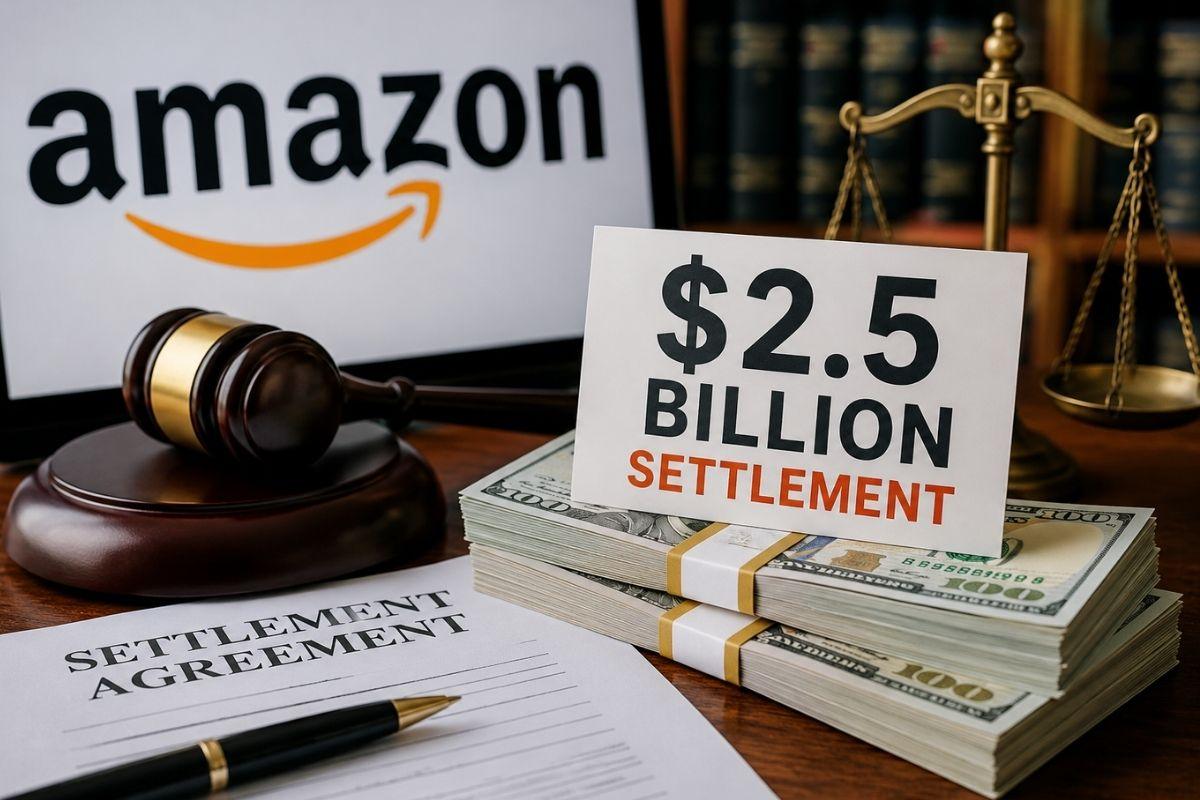
Millions of eligible U.S. Amazon Prime customers may receive a refund of up to $51 under Amazon’s $2.5 billion FTC settlement. The case covers Prime enrollments and cancellations between June 23, 2019, and June 23, 2025, and requires Amazon to change how it handles subscription sign-ups and cancellations.
Quick Facts
| Category | Details |
|---|---|
| Total Settlement | $2.5 billion |
| Consumer Refund Pool | $1.5 billion available for an estimated 35 million Amazon Prime members |
| Average Refund | Up to $51 per eligible person |
| Civil Penalty | $1 billion paid by Amazon to the U.S. Treasury |
| Claim Deadline | July 27, 2026 |
| Eligibility Window | Consumers who enrolled in or attempted to cancel Amazon Prime between June 23, 2019, and June 23, 2025 |
| Case Name | FTC v. Amazon.com, Inc., No. 2:23-cv-00932-JHC (W.D. Wash.) |
What Happened: The Settlement in Brief
Amazon agreed in September 2025 to resolve a Federal Trade Commission lawsuit accusing the company of enrolling customers in Prime without clear consent and making it deliberately hard to cancel. The court entered the settlement on September 25, 2025.
The $2.5 billion settlement has two separate components. The first is a $1.5 billion consumer refund fund covering an estimated 35 million Prime members, with individual payments capped at $51. The second is a $1 billion civil penalty paid directly to the U.S. Treasury, not to consumers — this is the largest civil penalty the FTC has ever obtained for a rule violation of this kind.
Refunds are moving in two stages. Automatic payments to consumers Amazon could directly identify went out between November and December 2025. A separate claims process for everyone else opened January 5, 2026, and closes July 27, 2026, with payments expected to go out by September 2026.
What Did Amazon Actually Do Wrong?
The FTC’s core allegation was straightforward: Amazon used dark patterns — user-interface designs built to steer people toward a choice they might not otherwise make, rather than presenting options in a neutral way — to enroll customers in Prime memberships they didn’t clearly agree to.
According to the FTC’s complaint, this happened in specific places across Amazon’s site: the checkout flow, the shipping-options page, and the Prime Video sign-up screen, among others. A shopper trying to complete an unrelated purchase could end up opted into a recurring Prime subscription through a confusingly worded button or a preselected option, without a clear, separate choice to decline.
The FTC also alleged that once someone was enrolled, canceling was intentionally convoluted — a multi-step, multi-page process that critics nicknamed internally, according to earlier reporting on the case, something close to a maze by design. This combination — unclear enrollment plus difficult cancellation — is what triggered a ROSCA violation. ROSCA, the Restore Online Shoppers’ Confidence Act, is a federal law requiring that businesses selling subscriptions online clearly disclose the terms, get a consumer’s informed consent before charging them, and provide a simple way to cancel.
Why This Case Is Bigger Than a Refund Check
Four things make this settlement more consequential than the payout amount suggests.
- It’s a record penalty, not just a payout. The $1 billion civil penalty is the largest the FTC has secured in a rule-violation case. That figure functions as a warning shot: regulators are willing to seek penalties at a scale that changes the cost-benefit calculation for large subscription businesses, not just a wrist slap folded into the cost of doing business.
- It forces structural change, not a one-time check. Beyond the money, Amazon is required to add a clear, visible option to decline Prime during checkout and to simplify its cancellation flow. That’s a permanent redesign obligation, not a settlement that ends once refunds are mailed out.
- It signals industry-wide scrutiny. The FTC has been building ROSCA enforcement cases against subscription businesses for several years, and this case — against the largest e-commerce company in the country — sets a visible benchmark. Other companies that rely on auto-renewing subscriptions and multi-step cancellation flows now have a concrete example of what regulators consider a violation, and what it can cost.
- Amazon settled without admitting liability. This is a specific legal distinction worth understanding. In a settlement of this kind, the company agrees to the monetary terms and the behavioral changes without a court or the FTC formally establishing that the underlying allegations were proven at trial. Amazon has publicly maintained that it followed the law and settled to move forward rather than continue litigating. Practically, this means the settlement resolves the case and secures relief for consumers, but it does not carry the same legal weight as an admitted or adjudicated finding of wrongdoing.
Are You Eligible?
You don’t need to figure this out yourself — Amazon and the settlement administrator determine eligibility based on your account history. Broadly, the criteria are:
- You are a U.S. consumer who signed up for Amazon Prime between June 23, 2019, and June 23, 2025.
- You enrolled through, or attempted to cancel through, one of the enrollment flows the FTC specifically challenged — including the Prime decision page, the shipping-selection page, single-page checkout, or the Prime Video enrollment flow.
- Your Prime usage during the relevant period was limited — reporting on the claims process indicates this generally means using more than three but fewer than ten Prime benefits in any 12-month span, consistent with someone who signed up without meaning to or struggled to get out of the subscription.
If you meet these conditions, you may be eligible whether or not you remember the specific screen you signed up through.
RELATED STORIES


Refund Timeline: What’s Already Happened, What’s Next
| Stage | Status | Dates |
|---|---|---|
| Stage 1 — Automatic refunds | Complete | November–December 2025 |
| Stage 2 — Claims process open | Open now | Opened January 5, 2026 |
| Claim filing deadline | Upcoming | July 27, 2026 |
| Expected claim payments | Pending | By September 2026 |
If you already received an automatic deposit or check in late 2025, you don’t need to file anything further. If you didn’t receive an automatic payment but believe you qualify, the claims window closes July 27, 2026.
How to Check If You’re Owed Money
The safest starting point is the FTC’s own refund page at ftc.gov, which links to the official, court-approved claims administrator site, Subscription Membership Settlement. Filing generally requires the email address associated with your Amazon account, since eligibility is matched against Amazon’s own enrollment records.
If you were sent a claim ID and PIN by mail or email from the settlement administrator, keep them on hand — they speed up the process but generally aren’t required to start a claim. Approved payments have reportedly been issued by check, PayPal, or Venmo, depending on the option selected.
Avoid searching generically and clicking the first result — settlement claims of this size reliably attract copycat sites designed to harvest personal or financial information. Starting from ftc.gov and following its link is the most reliable way to land on the legitimate site.
Watch Out for Scams
The FTC has stated plainly that it will never contact consumers by phone, text, or email asking them to pay a fee, provide a Social Security number, or share bank login details in order to “release” a refund from this settlement. Filing a claim is free, and no legitimate communication about this settlement will ask for payment to process it. If you receive a message like that, it’s a scam — don’t respond, and consider reporting it to the FTC at reportfraud.ftc.gov.
What This Means Going Forward
This case is a marker of where subscription regulation is heading, not an isolated event. The FTC has signaled, through both this settlement and earlier ROSCA enforcement actions, that “dark pattern” checkout design — preselected options, confusing cancellation flows, and buried terms — is now squarely in its enforcement sights, regardless of company size.
For consumers, the practical takeaway extends beyond this one refund: it’s worth periodically auditing your own recurring subscriptions — streaming services, retail memberships, app trials — for the same red flags the FTC identified here: enrollment you don’t clearly remember agreeing to, and a cancellation process that takes more than a click or two.
Conclusion
The Amazon Prime FTC settlement is about more than a refund. Eligible consumers can receive up to $51, but the broader impact is the FTC’s record $2.5 billion enforcement action, new requirements for transparent subscription practices, and stronger protections against deceptive online enrollment and cancellation methods. Anyone who believes they qualify should check their eligibility before the July 27, 2026 deadline.
FAQs
How do I know if I’m eligible for the Amazon Prime settlement refund?
You may be eligible if you signed up for Prime between June 23, 2019, and June 23, 2025 through one of the enrollment flows the FTC challenged, or tried to cancel and found it difficult. Eligibility is confirmed by Amazon and the settlement administrator, not something you need to calculate yourself.
What is the deadline to file an Amazon Prime settlement claim?
The claim filing deadline is July 27, 2026. Anyone who already received an automatic refund in late 2025 does not need to file separately.
How much money will I get from the Amazon Prime settlement?
Individual payments are capped at up to $51, though the final amount can be lower depending on how many valid claims are submitted, since the $1.5 billion consumer fund is fixed.
Is the Amazon Prime settlement refund text/email a scam?
It can be. The FTC will never call, text, or email you asking for payment, a Social Security number, or bank details to release your refund. Legitimate claims are filed for free through the official settlement site linked from ftc.gov.
Did Amazon admit wrongdoing in the settlement?
No. Amazon agreed to pay the settlement and change its enrollment and cancellation practices without admitting liability, meaning the allegations were not formally proven against the company in court.
Sources
- Federal Trade Commission: Official Amazon Refunds
- Subscription Membership Settlement: FTC v. Amazon.com, Inc., No. 2:23-cv-00932-JHC SETTLEMENT
- CNBC: How to claim part of the historic $2.5 billion Amazon Prime settlement and cancel unwanted subscriptions
- Yahoo Finance: Amazon Prime FTC settlement claims deadline July 27, 2026
- AP News: Amazon to pay $2.5 billion to settle FTC allegations it duped customers into enrolling in Prime
Disclaimer: This article is for informational purposes and does not constitute legal or financial advice. To determine your specific eligibility or claim status, consult the official FTC and settlement administrator resources linked above.