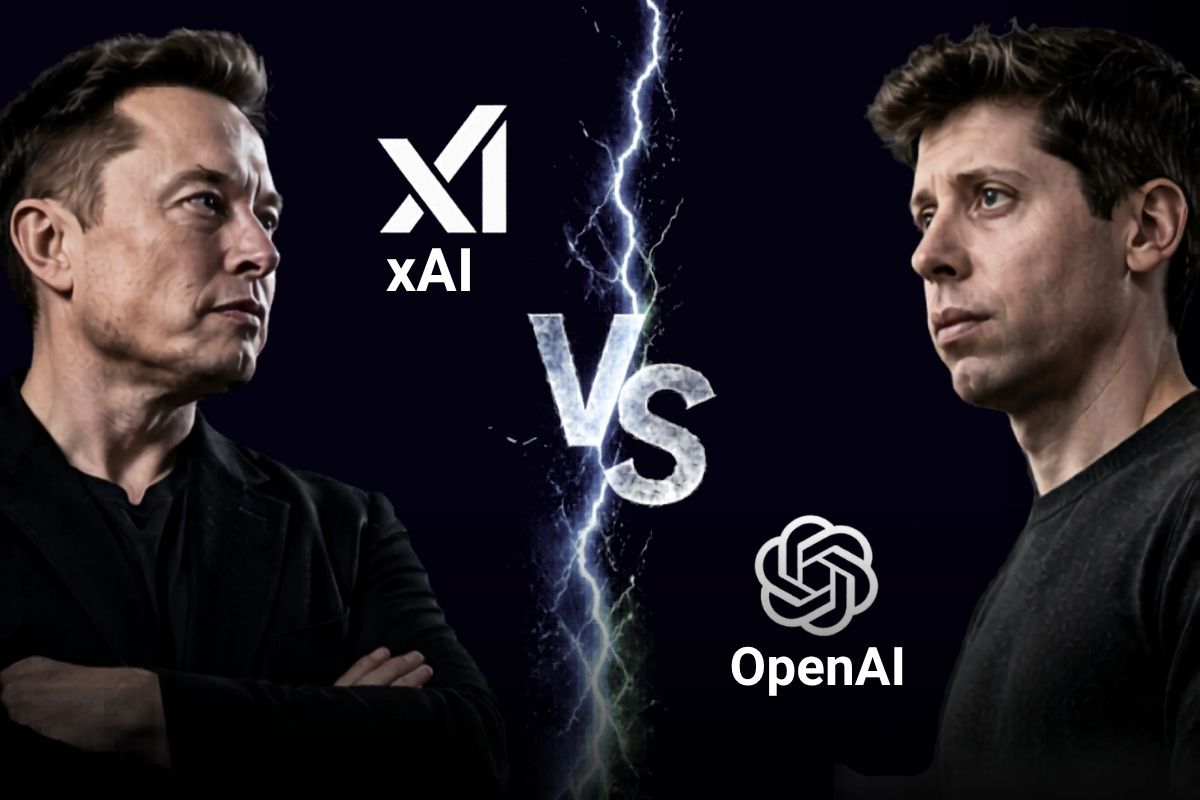
The month of April 2026 has brought about a significant change in the tech industry, making it look like a legal thriller. Right now, in a courtroom in Oakland, California, a jury is watching a billionaire-on-billionaire brawl that could fundamentally rewrite the rules of the Silicon Valley road. The court case, which started on April 27, 2026, has seen Elon Musk throw a significant punch at OpenAI, a business venture that he helped create in 2015.
It is not just any other legal case between two companies fighting over the technicalities of their contracts. We’re talking about a $134 billion fight for the steering wheel of human intelligence. The core question on everyone’s lips from London to New York remains the same: is Elon Musk’s XAI vs OpenAI a fair fight, or is one side just blowing smoke?
For folks trying to keep their heads above water with all the jargon, the drama is thick enough to cut with a knife. Musk argues that Sam Altman and the crew at OpenAI basically “stole a charity” to build a private gold mine for Microsoft. OpenAI’s defense?
They claim Musk is just acting like a “bitter rival” who’s late to the party and trying to trip them up to give his own company, xAI, a chance to catch up. It’s a messy, loud, and incredibly expensive spectacle that has forced the world to ask if AI should be a public good or a private paycheck.
The 134 Billion Dollar Betrayal
So, why are these guys actually in court? The whole Elon Musk XAI vs OpenAI mess boils down to a broken promise. Back in the day, Musk co-founded OpenAI as a non-profit. The goal was to build “Artificial General Intelligence” (AGI) that would belong to everyone. But as the years ticked by, OpenAI shifted gears.
By 2019, they weren’t just a charity anymore. They became a “capped-profit” entity and hopped into bed with Microsoft for billions of dollars.
Musk isn’t just annoyed; he’s litigious. He testified earlier this week that this shift was a total betrayal of the original mission. As reported by BBC News, he’s seeking massive damages and wants the court to potentially strip Sam Altman of his CEO title. OpenAI’s lawyers aren’t taking it lying down, though.
They’ve basically called the lawsuit a “campaign of harassment” designed to boost Musk’s own chatbot, Grok. They argue Musk knew about the profit plans all along and only started complaining when he realized he wasn’t the one making the money.
Grok vs ChatGPT: A Clash of Personalities
While the lawyers are arguing over billions, the actual products are duking it out in the real world. OpenAI is still the king of the mountain with ChatGPT. It’s polished, it’s safe, and most people find it incredibly helpful for everything from writing emails to planning a holiday.
But Musk’s xAI has a different vibe entirely. Grok is built to be “maximum truth-seeking”, which is a fancy way of saying it’s got a bit of a rebellious streak and fewer filters.
The physical power behind xAI is no joke, either. Musk’s team built the “Colossus” supercluster, packed with over 100,000 GPUs. That’s a terrifying amount of computing power. Because Grok is plugged directly into the real-time data from X (formerly Twitter), it often knows about breaking news before ChatGPT has had its morning coffee.
But here’s the rub: being “less censored” is a bit of a double-edged sword. OpenAI spends a fortune on safety guardrails to keep its AI from going off the rails. Musk thinks those guardrails are “woke” nonsense. It’s a philosophical divide that feels very personal.
Also Read: 10 Powerful Chrome Extensions to Supercharge Work in 2026
The Trillion Dollar Tech Ecosystem
Money talks, and in 2026, it’s shouting. OpenAI is currently eyeing a massive IPO that could value the company at over $850 billion. That is a staggering number.
If Musk wins his case, or even if he just manages to drag it out long enough, that IPO could be in serious trouble. Investors are a nervous lot, and a judge potentially unwinding OpenAI’s profit structure is the kind of thing that keeps them up at night.
But don’t go thinking xAI is some scrappy underdog. The company is already valued at roughly $250 billion. When you look at the “Musk ecosystem”—SpaceX, Tesla, and now xAI—you’re looking at a combined force worth over $1.2 trillion.
Musk has built a massive infrastructure that allows xAI to scale at a speed that would make most startups dizzy. He’s publicly stated he wants xAI to beat OpenAI and Google by the end of the year. Given his track record with rockets, people are starting to take that threat seriously.
A Battle for the Soul of Silicon Valley
The ripple effects of this trial are hitting way beyond the US. The Guardian has pointed out that this is really a fight about the “soul of AI.” If Musk wins, it could force a massive shift in how tech companies handle their non-profit origins. It would be a nightmare for Silicon Valley’s legal departments, which have spent years turning open-source ideas into closed-source profits.
But even for the average user, the stakes couldn’t be higher. Are we better off having a highly curated and safe AI or a rough-edged, uncensored AI? The concern is that the rush towards “AI supremacy” could become so extreme that safety considerations are completely abandoned. Whether it’s Sam Altman’s vision of a corporate-backed future or Musk’s vision of a truth-seeking rebel, someone is going to win. And whoever wins will likely control the digital architecture of our lives for the next few decades.
What’s the Bottom Line?
The trial in Oakland is expected to go on for weeks, if not months. We’re going to see more leaked emails, more uncomfortable testimony, and almost certainly more spicy tweets. But the reality is that the gap between these two giants is closing. OpenAI has the head start, but xAI is packing the raw horsepower and a founder who doesn’t mind breaking things to get there.
It sort of feels like watching a high-stakes poker game where the players are using the fate of the internet as their chips. On one side, they say that they are protecting us; on the other, liberating us. Honestly, it’s hard to say who’s right. But one thing is for sure: the tech industry is never going back to the way it was. The “nice guy” era of AI development is dead and buried.
Also Read: How AI Is Changing Jobs In Manhattan Right Now And What It Means For Workers
Frequently Asked Questions
Is the Musk vs OpenAI trial open to the public?
Parts of it are, yes. It’s being held in Oakland, and journalists have been providing daily updates. Expect plenty of live-blogs as Musk continues his testimony.
Can I use xAI’s Grok right now?
Yes, if you’re a Premium subscriber on X. It’s built right into the platform. It’s definitely punchier and a bit more sarcastic than ChatGPT.
What happens if Elon Musk wins the lawsuit?
It could be a mess. He’s asking for over $130 billion in damages and for OpenAI to be forced back into a non-profit structure. That would likely cause a massive legal headache for Microsoft.
Is OpenAI still working with Microsoft?
Very much so. Microsoft has poured over $13 billion into the partnership. It’s one of the most powerful alliances in tech history, and it’s a big reason why OpenAI is so dominant.
Does xAI have enough computers to compete?
With the Colossus supercluster, they definitely do. Musk has secured enough GPUs to make them one of the top three most powerful AI firms in the world almost overnight.
Who is Sam Altman?
He’s the CEO of OpenAI. He’s become the face of the “responsible AI” movement, though Musk and others have criticized him for being too focused on profits.
At the end of the day, we’re just spectators in a war between titans. Whether it’s a “real threat” or just billionaire bluster, the fallout is going to hit us all eventually. Better keep your eyes peeled.