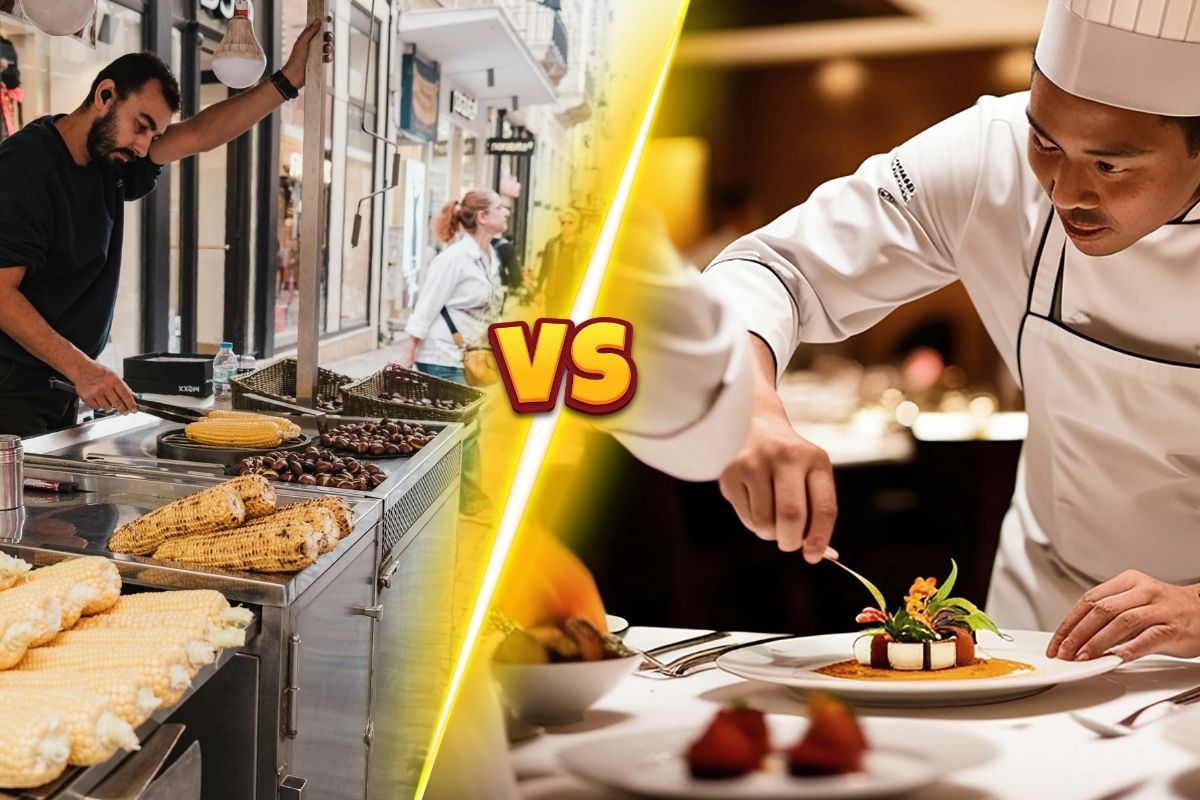
The food scene in April 2026 isn’t a battle anymore. It’s more akin to an absolute car wreck. The wall that once kept the “cheap eats” on the sidewalk and the “fancy stuff” behind white tablecloths has all but collapsed. Now, here you have Michelin-star chefs making high-end burgers in a park, while street vendors are using $20,000 lab equipment to produce taco sauce. This scenario is not only about what things cost. It is about what we do with our time. Do you want a 15-minute snack that blows your mind or a three-hour “experience” that tells a story? You can have both in 2026, and the quality gap is shrinking rapidly.
The Real Deal for 2026
- The High-Low Mix: About 73% of people are choosing “small plates” over full meals. They want the quality without the tie and jacket.
- Money Talk: The fine dining market is hitting roughly $360.9 billion this year, but quick street food is growing way faster.
- Tech in the Kitchen: We’re seeing “Shadow AI” predicting food truck traffic and robots doing the heavy lifting in both sectors.
- The Health Shift: It’s all about “better-for-you” foods. Think prebiotic burgers and mushrooms that help your brain.
- The Winner: The best spots right now are the ones doing both—fast service with top-tier, fancy ingredients.
The Rise of Gourmet Street Culture
The biggest thing happening right now is what people are calling the “Michelin Chicken” effect. It’s a bit of a joke, but it’s real. Fine-dining chefs are ditching their huge, expensive kitchens to open specialized stands for fried chicken or dumplings. As reported by GoFoodService, these “refined” versions of fast food are the hottest things on the menu in 2026.
The numbers back it up. Roughly 73% of diners say they’d rather go to a place that does a few small, incredible plates instead of a massive three-course meal. It gives you that fine-dining flavor but at a street-food pace. You’re seeing the old “Quick Service” model get a massive upgrade with local, organic stuff. The line between a food truck and a five-star restaurant? It’s getting really blurry.
The Battle for the American Wallet
Fine dining is still big, but let’s be honest—it’s becoming a “special occasion” thing. According to the National Restaurant Association, total US restaurant sales are set to hit $1.55 trillion in 2026. That’s huge. But the way that money is moving has changed.
Nearly 63% of people now prefer quick, casual spots over the old-school sit-down experience. There’s also this big “snacking shift.” About 57% of consumers are skipping full meals and just eating high-quality “snacks” all day. This is a massive win for street vendors. They can give you a world-class bite on the go while the big restaurants are still trying to get you to book a table two weeks in advance.
2026 Reality Check: Street Food vs. Fine Dining
| Feature | Street Food (The Daily Hustle) | Fine Dining (The Big Event) |
| The Vibe | “Eat and Go.” Very casual, high energy. | “Sit and Stay.” Intense storytelling and luxury. |
| Tech Used | Shadow AI for stock and AI kiosks. | Smart Kitchens and VR-led menus. |
| Avg. Price | $15–$30 for “Gourmet” versions. | $150–$400+ for the full experience. |
| Primary Goal | Efficiency, convenience, and bold flavors. | Emotional connection and “Human” service. |
| Health Trend | Prebiotic buns and low-sodium prep. | Adaptogenic menus and fermented foods. |
| Best For | A workday win or a quick weekend hangout. | Anniversaries, big wins, or “Bucket List” eats. |
Robots and Algorithms in the Kitchen
It doesn’t matter if it’s a truck or a lounge—the tech is everywhere now. In the street food world, “Shadow AI” is the big secret. Vendors use it to look at the weather and foot traffic to figure out exactly how much meat to buy. It cuts waste and keeps prices down.
Then you’ve got the fine dining side. They’re using technology to tell stories. As reported by Tastewise, social media and TikTok data are literally deciding what chefs put on the menu.
Some high-end spots are even using VR to show you the farm where your veggies grew while you eat them. And the robots? They’re real. Robotic arms for frying and plating are becoming a standard way to deal with the labor shortage hitting the industry this year.
The “Better-for-you” Food Craze
Street food used to mean greasy fries. The new trend in 2026 is “better-for-you” indulgence. People want a burger, but they want it to be low sodium and have things that are good for their gut. Fine dining is doing the same thing, but they’re using fermented foods and adaptogenic mushrooms to create “brain-boosting” menus.
Data from Xcel Global shows that everyone is looking for “heritage” cooking. They want food that has a history. This has led to a surge in street vendors specializing in old-school, hyper-local recipes that used to be hidden away in family kitchens.
Street Food vs Fine Dining: The Luxury of Choice
So, who wins? Honestly, it depends on your mood. Street food has won the battle for daily life. It’s where the innovation is happening. It’s the luxury of time—being able to eat a world-class meal on a sidewalk in ten minutes.
Fine dining has pivoted to be about the “Human Connection.” It’s an event. You pay $300 for the story, the service, and the memory. In a world full of robots, a “Premium Human” experience is the new luxury.
The coolest spots? They’re the hybrids. A chef might serve a $20 wagyu taco on a paper plate with a $50 glass of wine. It’s the “High-Low” blend that everyone wants right now. It proves that in 2026, the modern diner wants the quality of a palace but the vibe of a street corner.
The Bottom Line
Eating out in 2026 is a total adventure. The fight between street food vs fine dining has basically made everything better. Street food had to get more gourmet to stay relevant, and fine dining had to get faster and more “real” to keep people interested.
Yes, prices are high and the robots are in the kitchen, but food has never been better. Whether you’re going à la carte at an AI-run kiosk or sitting through a five-hour dinner “experience”, what’s on your plate comes with a story. You no longer need to sacrifice quality for speed in 2026. You just need to pick the vibe.
FAQs
Is fine dining getting cheaper?
Not really, but it’s getting more casual. Most places have dropped the dress codes and switched to “small plate” menus to keep things moving.
Why does street food cost $20 now?
Better ingredients. When you’re using organic, local beef and artisanal sauces, the price has to go up. You’re paying for quality, not just calories.
Are robot chefs taking over?
They’re helping out. They do the boring, repetitive stuff like frying chips or plating salads so the human chefs can focus on the flavors.
What is heritage cooking?
It’s about using ancient recipes and local ingredients that tell a story about a specific culture or place. It’s a huge trend in 2026.
Which one is healthier?
Both are better than they used to be. Street food has more “clean” options now, and fine dining is obsessed with gut health and fermented foods.
Also Read:
How AI Is Changing Jobs In Manhattan Right Now And What It Means For Workers