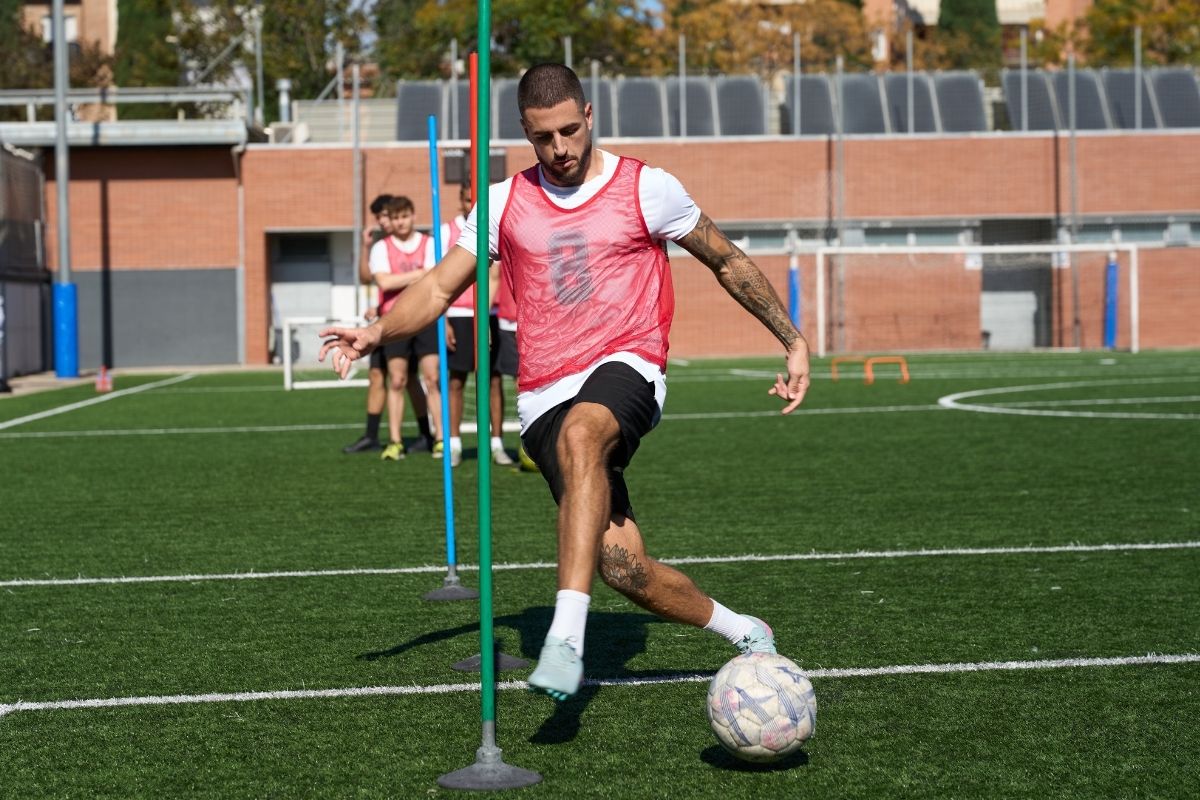
Improving dribbling skills in football requires regular ball handling, mastery of body control, and practice of football scenarios. It is not talent that counts. It is repetition and correct exercises. This blog shows where to focus, what to eliminate, and how to gain real dribbling confidence, whether you are a beginner or an experienced player.
Why Dribbling Is More Than Just Fancy Footwork
According to a 2019 study published in the Journal of Human Kinetics, technical ball skills such as dribbling are among the most powerful predictors of performance level in youth soccer players. However, the majority of players allocate less than 15% of their training time to work on individual skills.
Dribbling is the ability to beat defenders, create space, and hold onto the ball under pressure. Even the most athletic players can be limited without it.
The Core Skills That Actually Make You a Better Dribbler
Before you hit the ground, here are some of the essential skills that you can use to truly enhance your dribbling. A good dribbler is not only capable of performing intricate footwork, but also has habits and abilities that can be coordinated even under the pressure of a game. For example, the way you stand in front of the ball or the accuracy with which you predict the moves of the defender.
These basic skills are what make players who only look good during practice different from those who actually manage to get past the defenders during the games.
| Skill | Why It Matters |
| Close Ball Control | Keeps the ball within reach at speed |
| Change of Pace | Throws defenders off balance |
| Body Feints | Creates hesitation without touching the ball |
| Weak Foot Use | Makes you unpredictable |
| Head Up Awareness | Let’s You See Space While Dribbling |
Also Read: Iris van Herpen’s Brooklyn Museum Show Features 140+ Wildest Dresses
Step-by-Step: How to Improve Dribbling Skills in Football
This progression here is effective for players of all ages and skill levels:
- Start slow with cone dribbling. Try to set up 6-8 cones of various sizes in a straight line, 1 yard apart. Weave in and out of the cones with both feet. Focus on the standard of touches, rather than speed.
- Slowly add pace. When you find the dribbling familiar, speed it up through the cones. Measure yourself to see if you are getting faster.
- The inside-outside touch practice. Use the inside and outside of your foot alternatively. Most dribbling moves are based on this one.
- Only one move at a time to learn. Really get to know the step-over before moving on to the scissors or Cruyff turn. It is generally better to be deep than to be wide.
- Simulate pressure. First, a teammate defends you passively, then actively. Improvement in real situations is done through practice at game speed.
- Do a weak foot workout every day. A ten-minute weak-foot cone exercise can yield visible results within a month.
Quick Takeaways to Apply at Your Next Session
- Keep your head up while dribbling. Don’t get your eyes glued to the ball.
- Try to involve both feet in every training session, even if it is for a little while.
- Play 1v1 situations with your partner twice a week at least.
- Concentrate on mastering a single movement until it becomes instinctive, then introduce a new one.
- Try to take videos of yourself once in a while. You will probably discover some habits you were not aware of.
Put It All Together and Get on the Ball
Knowing the ways through which you can work on dribbling skills in football is just the beginning. Turning that knowledge into skills is something only practice can do. Select a couple of drills from this list, dedicate 20 minutes to them daily, and over a month, you’ll see the results.
Grab a football, arrange some cones, and start your training from today. Remember, the session you miss is the only one that doesn’t help you.
Also Read: Exclusive List of Celebrities from Manhattan You Should Know
Frequently Asked Questions (FAQs)
How long does it take to improve dribbling in football?
Most players experience real changes within 4–6 weeks of diligent daily practice — even just 20 minutes a day can produce a noticeable effect.
What is the best drill to improve dribbling?
Practicing cone weaving with both feet is thoroughly fundamental. For the quickest progress in real matches, combining this drill with 1v1 defending is a good idea.
Can I improve my dribbling by myself?
Of course. Working on solo cone skills, wall passing, and freestyle juggling all enhance the ball control and confidence necessary for the application in actual matches.
What age is best to start working on dribbling?
There is no wrong age to decide, but the studies indicate that 8–14 years present a technically critical development phase for footballers.
Does juggling help with dribbling?
It works on your first touch and the sense of the ball, which indeed extends to dribbling. However, it should not be a replacement for focused dribbling practice.